
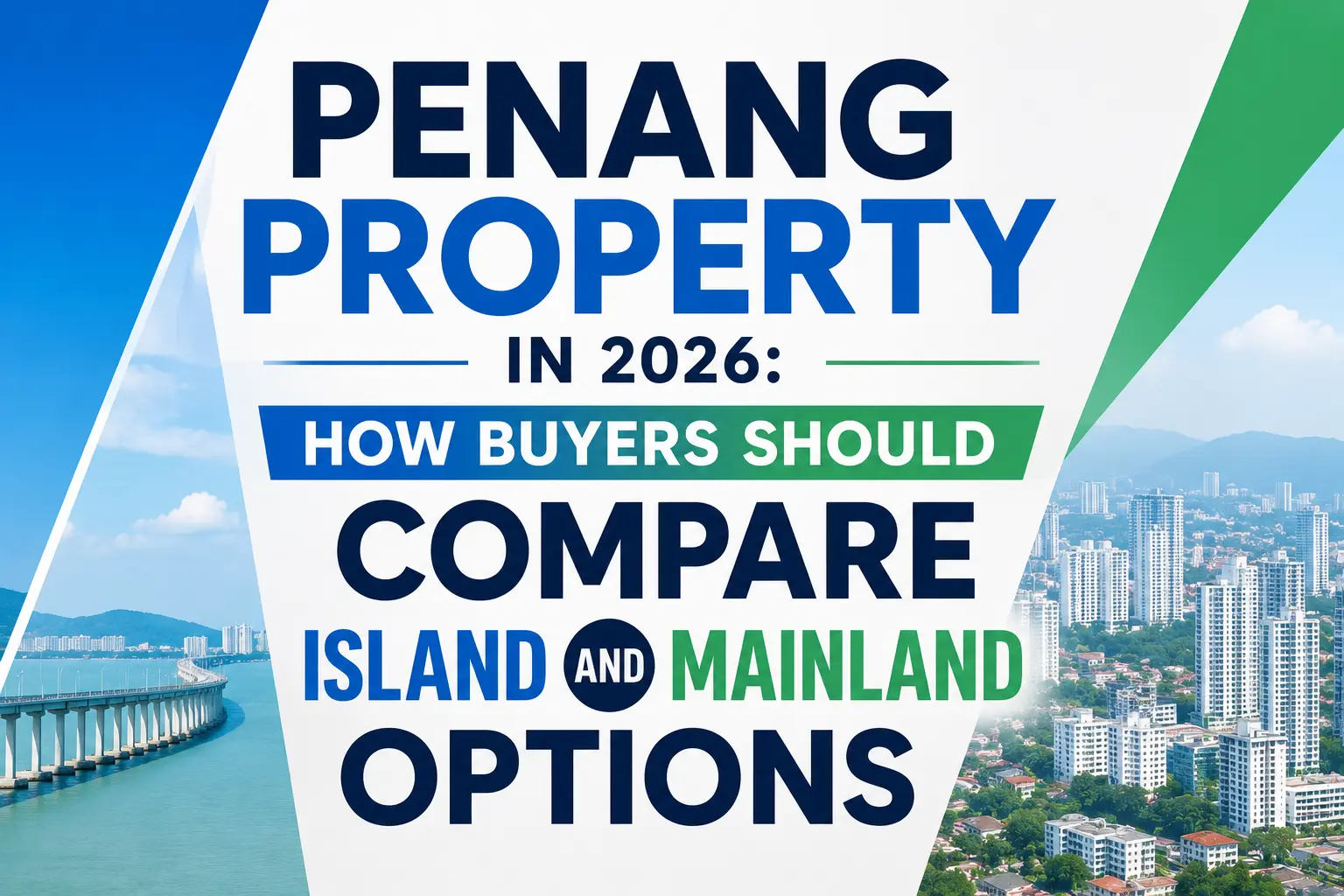
Penang buyers often compare the island with Seberang Perai. The right answer depends on commute, property type, budget, lifestyle and future supply—not prestige alone.
One state, several very different markets
Penang’s property market cannot be reduced to a single price trend. George Town, Gurney, Tanjung Tokong, Bayan Lepas, Batu Ferringhi, Butterworth, Bukit Mertajam and Batu Kawan each serve different demand pools.
The island typically offers stronger lifestyle and established-amenity appeal in many locations, while mainland areas can provide more space and newer landed options at lower entry prices. That is a broad pattern, not a rule.
Start with the daily journey
For owner-occupiers, commute is often more important than price per square foot. A cheaper home that adds an hour of daily driving may not be cheaper in lifestyle terms. Test the actual route during peak hours and consider bridge dependence, school runs and public-transport options.
If you work in Bayan Lepas or an industrial corridor, proximity to employment may create a different shortlist than if your daily life centres around George Town.

Compare like with like
Do not compare a 900 sq ft new condominium on the island with a 1,800 sq ft mainland terrace house using price per square foot alone. They provide different land ownership, maintenance obligations, facilities, density and lifestyle.
Instead, compare total monthly housing cost, usable space, parking, security, maintenance, renovation budget, commute and expected holding period.
Investors need a tenant story
A rental property should have a clear tenant profile. Is the unit meant for professionals near industrial employment, medical staff, students, expatriates, tourists or local families? Each group values different locations, layouts and furnishings.
If you cannot explain why a tenant would choose your unit over five nearby alternatives, your investment thesis is incomplete.
Check future supply
NAPIC’s Q1 2026 publications include state transaction and residential stock data that buyers can use to understand activity and available supply. Pair that information with on-the-ground research into projects under construction.
A neighbourhood with strong infrastructure can absorb new supply. A location with many interchangeable units and weak job growth may take longer.
Choose for your own objectives
There is no universal answer to “is island or mainland better?” The better property is the one with sustainable financing, strong daily usability and a demand base that matches your reason for buying.
For many families, the right choice is ultimately a practical one: where you can live well, keep monthly commitments comfortable and still have a property that other households are likely to value in the future.
Practical next steps
- Test real peak-hour travel on both island and mainland options.
- Compare total monthly cost, not price per square foot alone.
- Identify the future tenant or buyer pool before investing.
The Tera & Co. takeaway
Good property decisions come from combining market context with property-specific due diligence. Use broad market data to understand the environment, then make the final decision using financing, recent comparable transactions, condition, location, legal documentation and your own holding period.
Sources and further reading:
Information is general in nature and is not legal, tax, investment or financing advice. Rules, rates and eligibility can change; verify material details with the relevant Malaysian authority or qualified professional.



Join The Discussion